
Clinically proven
Studies & Clinical Evidence
It has been proven that moving the joint early and in a controlled manner after surgery helps patients recover faster and prevents stiffness. Continuous Passive Motion (CPM) therapy—continuous passive movement—has proven particularly effective for this purpose.
Therapy principle
Why CPM therapy works
CPM stands for Continuous Passive Motion, i.e., continuous passive movement therapy. This principle has been established for decades in the rehabilitation of knee and shoulder joints and is now also available for the hallux.
Controlled, passive movement of the joint immediately after surgery distributes synovial fluid, promotes cartilage nutrition, and prevents adhesions. The joint remains mobile and healing progresses faster.
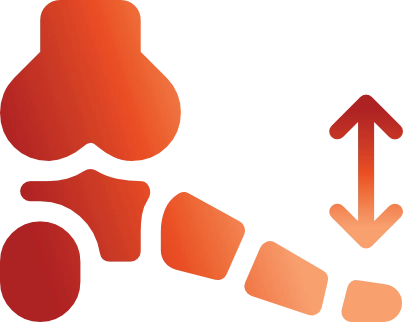
Passive mobilisation of the joint—the principle of CPM therapy, shown schematically.
Reference studies
The scientific basis
Clinical evidence on stiffness after immobilisation, shortened recovery through toe CPM devices and physical therapy after hallux surgery, as well as the general benefits of CPM therapy after joint interventions.
Akeson et al. (1987)
Stiffness after immobilisation
After just one week of immobilisation, the synovial membrane shortens, adhesions form in the joint lining, and permanent restrictions in mobility can occur.
1 week
One week of immobilisation is enough to cause joint stiffness
Akeson, W. H. et al. (1987). Effects of immobilization on joints. Clinical Orthopaedics and Related Research.
Connor et al. (1995)
Toe CPM shortens rehabilitation
Motorised toe CPM devices shorten rehabilitation time after MTP-I joint surgery by up to 10 days compared with physiotherapy alone. Range of motion increases sooner, and patients return to normal weight bearing faster.
10 days
back to full mobility faster
Connor, G. F. et al. (1995). Continuous passive motion after MTP-I surgery. Foot & Ankle International.
Schuh et al. (2008)
Benefit of physical therapy after hallux surgery
Targeted movement therapy after bunion surgery significantly improves big-toe function and physiological gait pattern, increases peak pressure, range of motion, and the AOFAS score.
up to 4×
higher load bearing of the big toe after 6 months
Schuh, R. et al. (2008). Effect of Physiotherapy on the Functional Improvement after Hallux Valgus Surgery. Z Orthop Unfall, 146, 630 to 635.
Schuh et al. (2009)
Benefit of physical therapy after hallux surgery
Physical therapy and gait training improve loading of the first ray during the stance phase. Within six months after surgery, maximum force in the big toe increased significantly, and patients returned to physiological weight bearing.
6 months
until weight bearing of the first ray is restored
Schuh, R. et al. (2009). Importance of Physical Therapy to Restore Weight Bearing of the First Ray During the Stance Phase. Phys Ther, 89, 934 to 945.
Michael et al. (2005)
General CPM effectiveness
Using a motorised shoulder CPM device in addition to physiotherapy enabled patients to regain full active mobility around twelve days earlier than with physiotherapy alone, while also reducing pain sooner.
12 days
earlier to full active mobility
Michael, J. W. P. et al. (2005). Efficiency of a Postoperative Treatment after Rotator Cuff Repair with a Continuous Passive Motion Device (CPM). Z Orthop Ihre Grenzgeb, 143, 438 to 445.
Garofalo et al. (2010)
General CPM effectiveness
Four weeks of accompanying CPM use significantly improved both mobility and pain control in the early rehabilitation phase after shoulder surgery compared with standard therapy alone.
less pain
and more mobility in early rehab
Garofalo, R. et al. (2010). Effects of one-month continuous passive motion after arthroscopic rotator cuff repair. Musculoskelet Surg, 94 (Suppl 1), S79 to S83.
All
Jaspers et al. 2018
General CPM effectiveness
A Continuous Passive Motion (CPM) device significantly improves range of motion after ACL reconstruction and reduces pain and swelling. Knee flexion improved in postoperative weeks 1 to 6, and swelling decreased between weeks 4 and 6.
Week 1 to 6
better knee flexion and less swelling after ACL surgery
Continuous Passive Motion (CPM) does improve range of motion, pain and swelling after ACL reconstruction: a systematic review and meta-analysis.,“/pubmed/ 30321902″,“Jaspers T, Taeymans J, Hirschmüller A.“,“Z Orthop Unfall 2018 Oct
What these studies mean in practical terms
| ✓ Shorter recovery, faster return to a physiological movement pattern | ✓ Prevention of joint stiffness and permanent adhesions |
| ✓ Promotes joint mobility and distribution of synovial fluid | ✓ Secures surgical success through early mobilisation |
| ✓ Remobilisation of already stiffened joints possible within 30 days | ✓ Pain relief through even, controlled movement |
Clinical assessment
Patients report easy handling, clear instructions for use, noticeably increasing mobility, and a shorter recovery time. I recommend the device for broad clinical use in postoperative bunion correction treatment.
Learn more